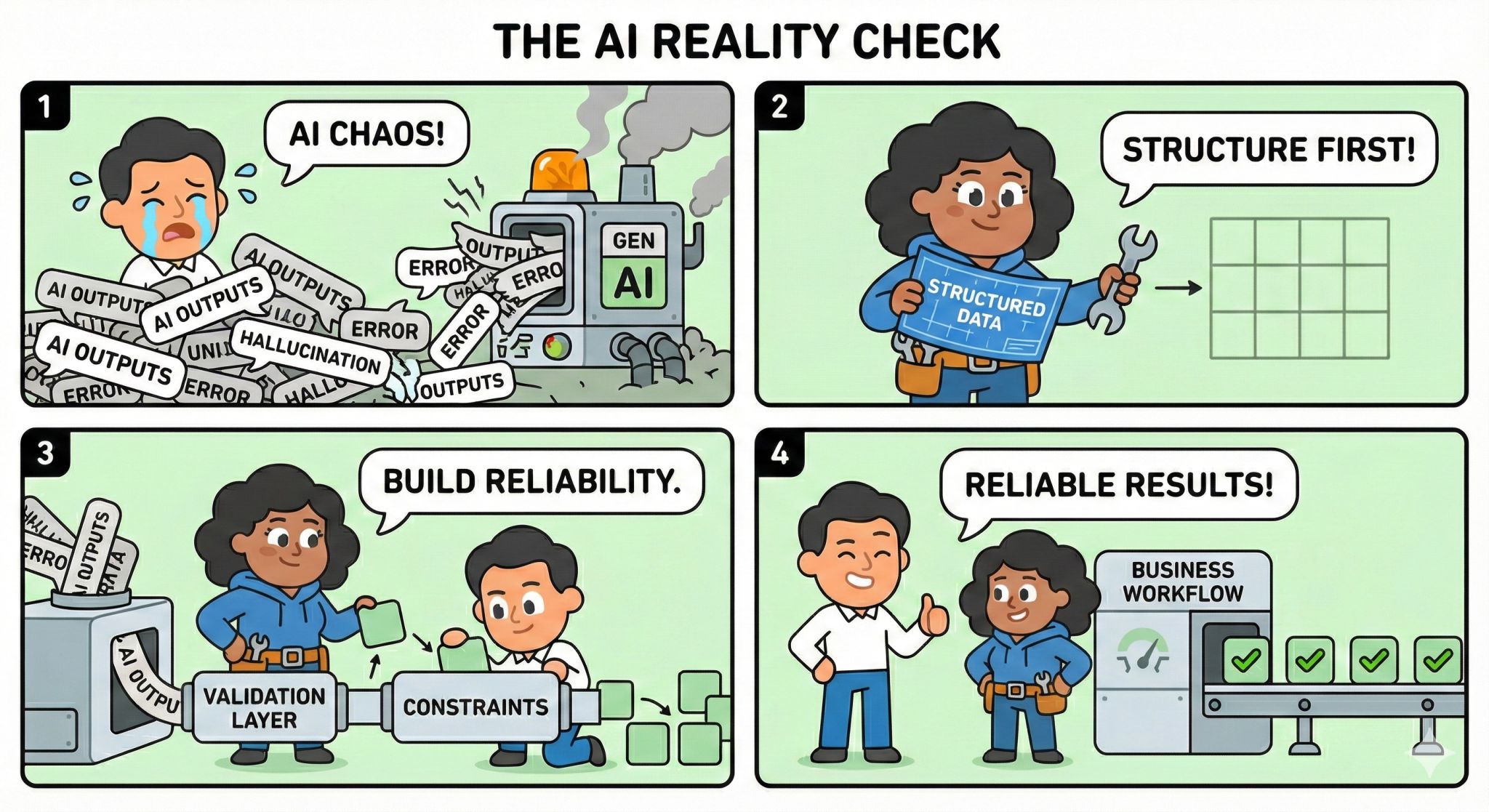

Last month we worked with an enterprise team whose AI deployment completely failed.
Their story is becoming way too common.
The issue wasn’t the model or the data. They jumped straight to complex implementations without solving structured outputs first.
Their LLM was generating inconsistent responses, breaking their entire workflow. Sound familiar?
The real bottleneck
After analyzing dozens of failed AI implementations across Fortune 500 companies, here’s what we discovered: the real bottleneck isn’t model performance.
It’s getting reliable, structured data you can actually use in business workflows.
3 patterns we see in every successful deployment
- Constrained outputs — Start with constrained outputs before scaling complexity.
- Validation layers — Build validation layers that catch inconsistent responses.
- Fallback systems — Design fallback systems for when AI fails (because it will).
The difference is dramatic. Teams that follow this approach see 10x better adoption rates and significantly fewer production issues.
One engineering leader recently told me this approach saved their team 6 months of rework.
What forward deployed engineers do differently
Most AI consultants sell you the flashy stuff – latest models, impressive demos, big promises.
Forward deployed engineers focus on what actually works in production.
We embed with your team. We solve the boring infrastructure problems that matter. We make AI reliable enough to bet your business on.
Because unreliable AI isn’t AI at all. It’s expensive random text generation.
What’s the biggest AI challenge you’re facing right now? Email rgupta@trao.ai and we’ll share specific solutions that worked for similar companies.