I’ve been thinking a lot about how organizations can build lasting competitive advantages – moats – in the era of AI.
One of the clearest answers is memory. Let me explain.
Memory lives in the environment
The big model companies (OpenAI, Anthropic, etc.) want to grow fast. So their job right now is to make the experience feel magical. To do that, every user session needs to feel more personal than the last.
That basically means they need to still memory.
Right now, that memory doesn’t live inside the model. It lives in the environment – the layer between the model, its tools, and the data.
And whoever designs that environment ends up controlling how memory works.
Who controls the environment
The problem is that model providers are now offering the whole environment themselves. Anthropic’s managed agents are the latest example: agents that run longer, remember more, and improve with almost no setup.
For an individual, that’s convenient. You just want the agent to get smarter and do the work.
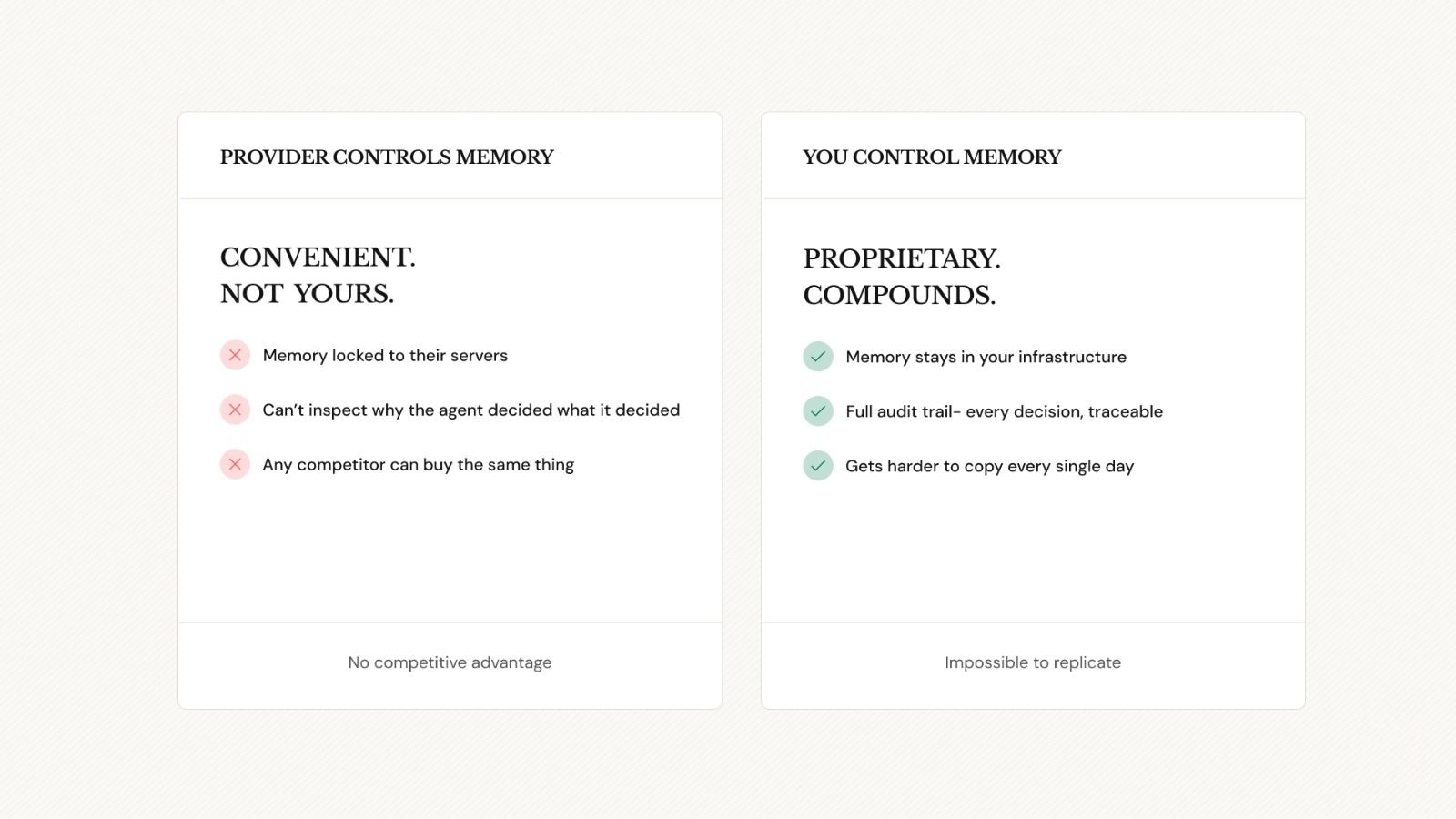
For a company, it’s different. Without memory, your agents are easy to copy. But with memory, you start building a proprietary record of how your organization actually thinks and operates.
But when the providers control the environment, that record stays locked with them. You can’t inspect it. You can’t move it. And you can’t really understand why the agent decides what it decides.
Owning your advantage
Memory is becoming one of the deepest competitive advantages in the agentic world.
At Trao, we spend most of our time building these environments so organizations can own and protect their competitive advantages.
If you’re building AI systems inside your company, feel free to reach out at rgupta@trao.ai.