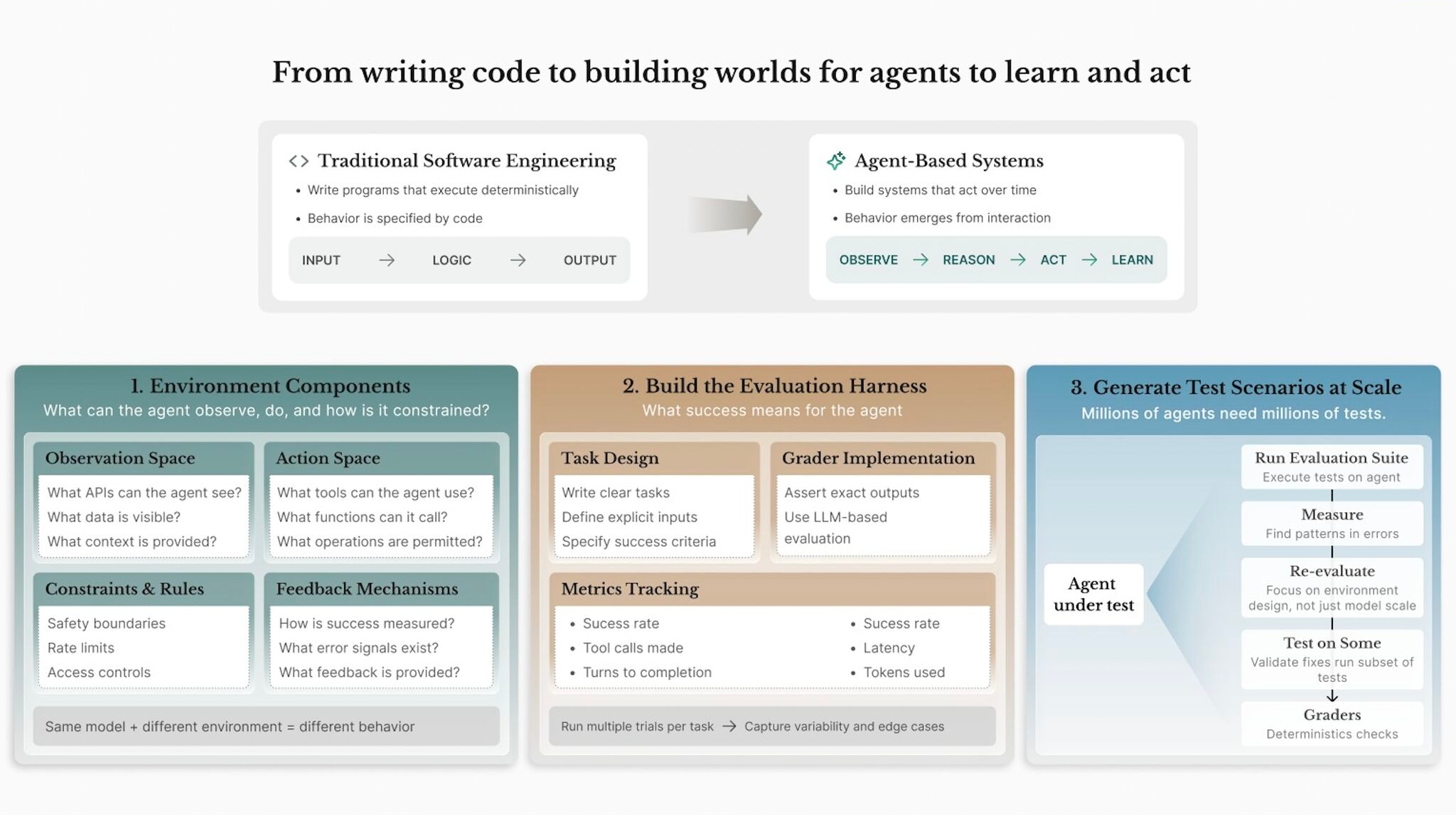






For several years, progress in AI could be explained in a simple way: models were getting better.
They understood more language, handled more tasks, and produced more convincing outputs. If a system behaved poorly, the usual explanation was that the model was not yet capable enough.
That explanation is becoming less useful.
The environment shapes behavior
As AI systems move beyond producing isolated outputs and begin to operate over time – calling tools, interacting with users, modifying state – their behavior depends less on raw model capability and more on the conditions in which they operate.
The same model can behave reliably in one setting and unpredictably in another. The difference is the environment.
An environment determines what the system can observe, what actions are available, what constraints are enforced, and how outcomes are evaluated. It defines what success means, what failure looks like, and whether the difference between the two can be detected at all.
Why evaluation depends on it
Without a well-designed environment, evaluation becomes unreliable. If evaluation is unreliable, improvement becomes guesswork.
Millions of agents need millions of tests
This problem becomes more acute as the number of agents increases. If software systems eventually rely on millions or billions of autonomous components, they will require correspondingly large numbers of tests, simulations, and counterfactual scenarios. They must be generated, varied, and exercised systematically.
In that sense, at Trao, we believe the future of software engineering looks less like writing individual programs and more like designing the worlds in which agents will learn and act.